Ten Years In: What the PMI Program Taught Us About Building Poultry Systems That Last
Nearly a decade into the PMI, the WPF team has learned more from the unexpected than from anything that went according to plan. We asked team members across programs, finance, data, and field operations to share the challenges they didn’t see coming and what those challenges ultimately changed about how we work. This is part three in a three part series on unanticipated challenges and opportunities in the PMI Program over the last ten years.
By: Joe Antonio, Emmanuel Jalloh, Eve Kamba, and James Ferns
Part 3: Making It Work on the Ground: The operational and field realities that don’t show up in a program design document.
The PMI model has a clear structure and a sound commercial logic, but between the design and the outcome sits a thousand daily decisions made by field staff, farm operators, and partners working in some of the most complex operating environments in the world. Getting the expertise into the hands of the people making those decisions is the work. Four members of the WPF team walk through what that looks like in practice.
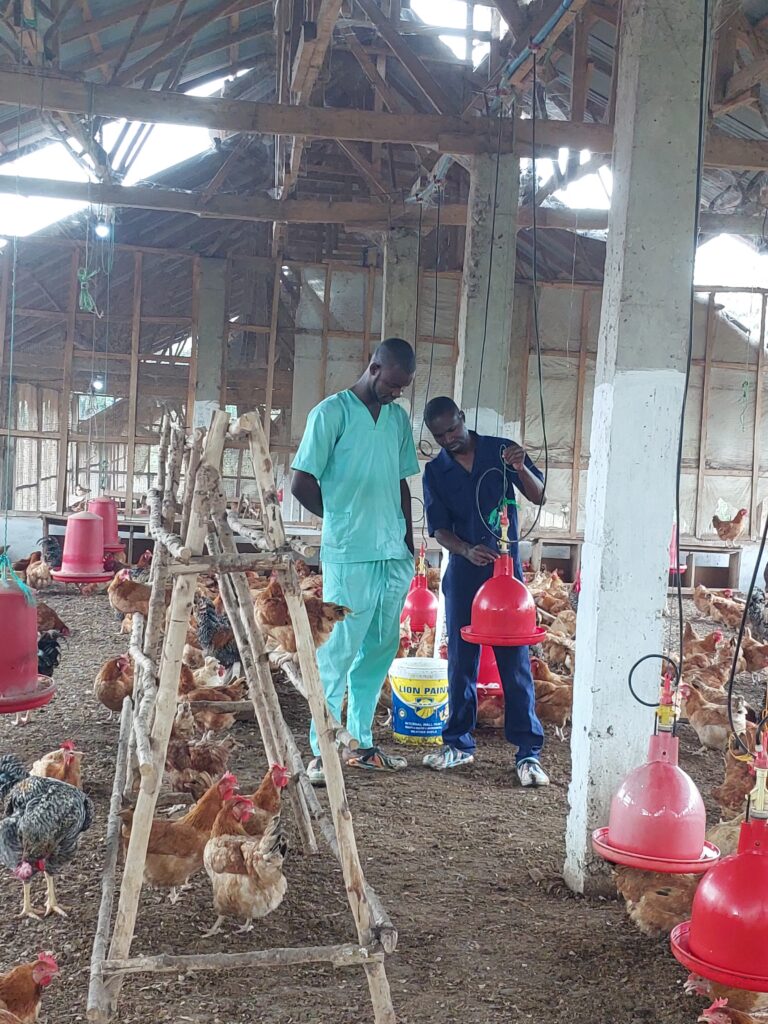
Joe Antonio works alongside private-sector partners in a parent stock house in Sierra Leone.
Joe Antonio, PMI Technical Director, came into the program expecting infrastructure builds and systems development to be the hard work. The facilities came together. What proved harder was the distance between having robust standard operating procedures, biosecurity protocols, and management systems in place on paper and having them applied the same way every day.
The challenge was ensuring that local teams consistently applied these systems while working within constraints,” Joe says. Supply chain disruptions, delays in sourcing equipment or breeding stock, inconsistent feed quality, and varying levels of technical experience all made adherence to the SOPs difficult. Those disruptions were the least predictable part. They can move performance significantly even when the planning has been careful.
His response was to get closer, not to tighten the rules. Hands-on coaching, regular performance reviews, and continuous mentoring did more to build operational consistency than any additional documentation could have.
What Joe adapted was not the standard but the path to it. “Rather than assuming international best practices could simply be transplanted, we adapted training, management systems, and implementation timelines to match the experience of local staff and the availability of resources.” Core technical standards held. Everything around them flexed.
The experience reinforced that sustainable poultry development is driven as much by people as by infrastructure. “Investing in local capacity, leadership, and ownership is just as important as investing in physical assets,” Joe says. He now places greater emphasis on mentoring teams and developing practical management systems they can sustain independently.
In the field, the details are everything
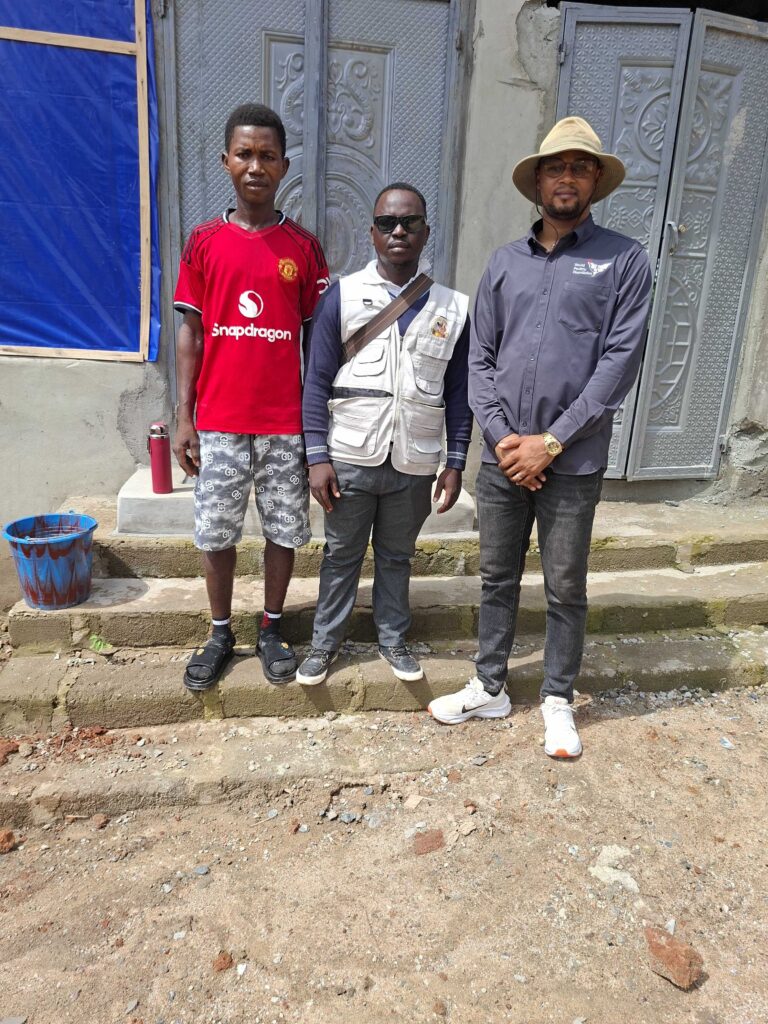
Emmanuel Jalloh meets with Field Service Representatives and a Brooder Unit.
That distance between a system and its consistent application is exactly what WPF In-Country Coordinator – Sierra Leone, Emmanuel Jalloh, ran into on what started as a routine site visit.
In one example, Emmanuel arrived at a partner parent stock farm and found an operation that was nowhere near ready. Sheds scheduled to receive day-old chicks that same afternoon were completely unprepared. Biosecurity protocols that should have been completed two weeks earlier hadn’t been started.
“We paused the formal evaluation and just got to work,” Emmanuel says. “Our team rolled up our sleeves and helped farm staff get through the biosecurity measures and shed setup before the birds arrived. We focused on fixing the problem first. The conversation about how it happened, and how to prevent it in the future, could wait.”
The experience stuck with him. Real partnership, he realized, means showing up and digging in when things go wrong, not just monitoring from a distance. And in poultry, the small things matter more than people expect. A missed biosecurity step isn’t a paperwork problem. It’s a flock at risk.
Since then, Emmanuel shifted how he works. He visits more often, checks earlier, and doesn’t wait for problems to surface before following up. Pre-placement audits are now a standard part of his rhythm, not because partners can’t be trusted, but because the cost of catching something late is always higher than the cost of checking in advance.
Training the people who stay
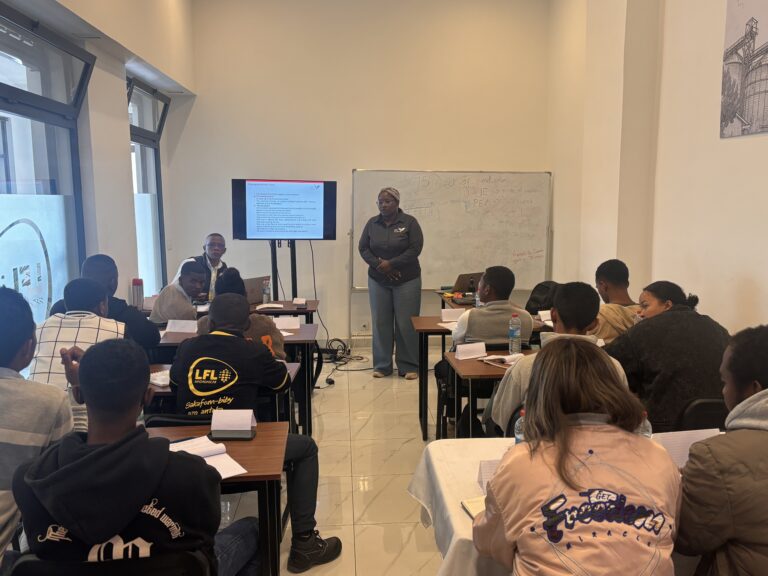
Eve Kamba trains new Field Service Representatives in Madagascar.
When WPF is gone, it’s the private-sector partner and their team who remain. Training is how the program prepares them for that. It covers bird health, biosecurity, production standards, and the data oversight that monitors all of it, so that the knowledge sits with the people who stay rather than the people who visit. What those teams can handle on their own determines whether the model holds.
But knowing the standard and getting a farmer to follow it are different problems. “Some farmers do not fully adhere to the PMI production model,” Training Manager Eve Kamba says. Many hold birds past the brooding stage rather than selling them on, which complicates the data FSRs collect through CommCare. Others are reluctant to change traditional production and adopt recommended biosecurity practices despite training and awareness efforts, which raises production risk and affects bird performance. Neither problem gets solved by better content. They get solved by an FSR who has built enough trust with a farmer to explain what the change does and why it is worth making.
So Eve built those realities into the curriculum. FSR capacity-building now covers farmer behavior, compliance challenges, and practical strategies for encouraging adoption, rather than treating them as issues to escalate upward.
Delivering that across eight countries is its own challenge. Different work cultures shape communication styles, decision-making, and timelines, and Eve’s response has been more contact, not less. Alignment meetings happen ahead of any training so objectives and expectations are agreed before anyone travels.
Those points of connection are about building judgment, not handing over an instruction manual. Working across multiple countries means WPF is rarely the one with the full answer, and partners understand their own markets, farmers, and constraints better than any external team can. Hybrid Poultry Farm in Zambia is a case in point. The company introduced its own recognition scheme, awarding compliant brooder units a “Hybrid Authorised Brooder Unit” poster and withdrawing it if standards slip. That kind of innovation comes from a partner invested enough to build it themselves, and it holds better than anything a one-size-fits-all program could have imposed.
Finance is a relationship, not just a system
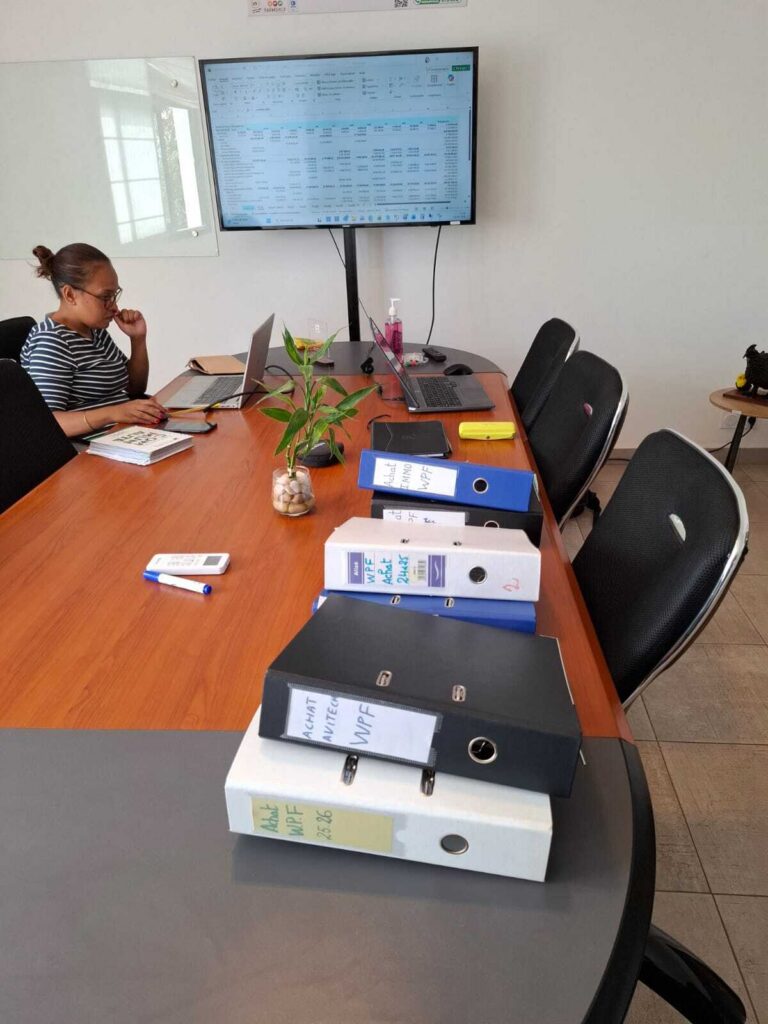
James Ferns meets with the finance team in Madagascar.
A poultry business lives or dies on numbers that get recorded daily. That work happens behind the scenes, but it is imperative to the success of a company and a program, and the difference between a value chain being profitable or not. WPF’s Financial Controller, James Ferns, knew documentation practices would vary across partners. What he didn’t fully anticipate was how inconsistent it would be.
“Poor documentation created significant stress for both our team and our partners,” he says. Rather than framing gaps as compliance failures, the team focused conversations on what those gaps put at risk. “That framing helped keep dialogue open, even when discussions were challenging.”
Weak record-keeping makes it harder for a business to see its own margins clearly, to follow a budget, and ultimately, to make strategic decisions about expansion or consolidation. Without that visibility, a partner is guessing.
One of James’s core lessons is about reading behavior over words. “We learned to pay closer attention to behaviors rather than relying solely on verbal assurances or written commitments. Consistent action, meeting deadlines, providing documents, following up, often tells us far more than what is said in meetings.”
Working in largely informal markets has reinforced the value of presence and directness. “Finance teams can lean too heavily on emails and written communication, especially when things get difficult,” he says. “We’ve learned the value of picking up the phone, having direct conversations, and overcommunicating when necessary. Flexibility, presence, and consistent follow-up often do more to build sustainable systems than sophisticated tools alone.” Coaching partners through the practice, rather than sending instructions, is what makes the system hold once WPF steps back.
What holds it together
The gap between a program model and a working program is closed by people. Those who show up, check in early, and refuse to let small problems become big ones are what make the difference between a value chain that holds and one that doesn’t.
But the goal is to hand all of that over to our private-sector partners. Every pre-placement audit, coaching session, and direct conversation is meant to become something a partner does on their own. The clearest sign it’s working is when a partner builds something WPF didn’t design.
A partner who follows biosecurity protocol because a coordinator is coming has a program. A partner who follows it because they understand what a lost flock costs them has a business.
The model gives you a structure. The people give you a program. What makes it last is when the people running it no longer need us.
L’Initiative pour la multiplication avicole (PMI) est le programme phare de la World Poultry Foundation (WPF) ; il s’agit d’une approche pilotée par le secteur privé visant à mettre en place des chaînes de valeur avicoles autonomes au sein des communautés rurales. Ce modèle repose essentiellement sur une chaîne simple : les couvoirs produisent des poussins d'un jour, les unités d'élevage les élèvent pendant quatre à six semaines, puis les petits producteurs achètent ces jeunes volailles pour les élever en vue de la production d'œufs et de viande. Chaque maillon de la chaîne constitue une véritable activité génératrice de revenus réels, et c'est cette logique commerciale qui assure la pérennité du modèle bien après la fin de l'implication directe de la WPF.
Au cœur du modèle PMI se trouve la volaille à double usage (DPP), une race qui se situe à mi-chemin entre les races commerciales et les poulets indigènes locaux. Les volailles DPP grandissent plus vite que les poulets de village, produisent davantage d’œufs et s’épanouissent dans des environnements ruraux à faibles intrants. L’introduction de cette race sur de nouveaux marchés et la mise en place des chaînes de valeur nécessaires à son développement constituent la mission du programme PMI. Cela semble simple. Dans la pratique, c’est rarement le cas.
CATÉGORIE
- Série APMI
- Carrières
- Éthiopie
- Ghana
- Cuba
- Inde
- États-Unis
- Kenya
- Membres du conseil d'administration de la WPF
- Zimbabwe
- Afrique
- Nigeria
- Rwanda
- Tanzanie
- Afrique du Sud
- Mentions dans les médias
- KZNPI
- Initiative africaine pour la multiplication des volailles
- De la route
- Programmes de formation
- Stages pour futurs agriculteurs
- Les gens dans le secteur avicole
- Communiqués de presse
EMPLACEMENT